The Compact took 17 years to finish
The Hilo Principles set the terms of free association. Armstrong and Hills date them to 1978, while Haglelgam says 1977; the contemporaneous AJIL article is better supported.11 Armstrong & Hills; Haglelgam The Compact was initialed in 1980, reviewed by the Reagan team, and signed with the FSM on 1 October 1982.
FSM voters approved it on 21 June 1983, by 20,121 votes to 5,348.22 Wikipedia, 1983 referendum Wikipedia shows 76.9%, but the counts give 79% of valid votes, matching Armstrong and Hills.
Pohnpei was the one state to vote no. Nationally, 58% chose independence on the fallback question.33 Wikipedia, 1983; FSM newsletter 1983
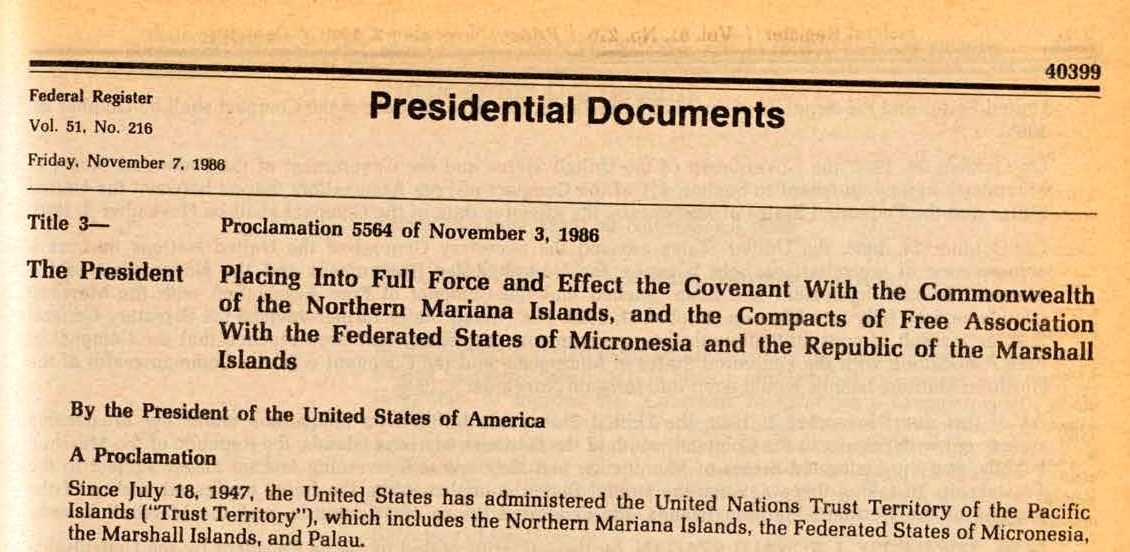
The FSM Government approved the Compact on 2 September 1983.44 Armstrong & Hills The US Congress passed it as Public Law 99-239 on 14 January 1986.55 PL 99-239, govinfo It entered into force on 3 November 1986.66 Wikipedia, TTPI
The Compact gave the FSM self-government and its own foreign relations, limited by US defense authority.77 Armstrong & Hills Grants ran for 15 years, while US “strategic denial” runs indefinitely. The Security Council formally ended the FSM trusteeship on 22 December 1990, by 14 votes to 1.88 UNSC Resolution 683
Security Council Resolution 703 (9 August 1991) recommended membership.99 Wikipedia, UNSCR 703 General Assembly resolution 46/2 admitted the FSM on 17 September 1991.1010 UN Digital Library The FSM has been a UN member since 1991.1111 FSM Office of the President
Three compacts, three funding eras
| Period | US assistance | Structure |
|---|---|---|
| Compact I (1987–2003) | Over $1.5 billion | Grants for 15 years |
| Compact II (2004–2023) | About $2.3 billion (GAO 2008 estimate) | Grants decline yearly while trust-fund deposits rise |
| Compact III (FY2024–2043) | $3.3 billion | $140 million a year in sector grants, plus $500 million to the trust fund; enacted 9 March 2024 as Public Law 118-421212 FSM JCRP; GAO-26-107778 |
Sources: GAO-08-859T; GAO-26-107778.
Under Compact II, government spending was about 65% of GDP in 2006.1313 GAO-08-859T In 2003, per-capita GDP was about $2,150, close to its 1991–95 level of $2,120,1414 GAO-08-859T and taxes covered under a quarter of revenue. The trust fund held $1.98 billion in November 2025.1515 GAO-26-107778
Open migration drained the population
Visa-free entry to the US drove a steep fall in population. GAO counts 102,843 people in 2010 and 75,817 in 2023, a drop of about 26%.1616 GAO-26-107778 A 2025 news report gives about 113,000, likely an old projection; the census figure is better supported.1717 PINA
Migrants from all three freely associated states grew from about 56,000 in 2009 to 94,000 in 2018.1818 Pacific Island Times About half lived on the US mainland. The 1996 welfare law cut them from Medicaid until Congress restored eligibility in December 2020.1919 Hawaii Public Radio