Eras
The modern history of the FSM in ten chapters. Each one has a short summary, the full sourced story, its key events and people, and where the evidence is disputed.
-
The contact era
, 1820s–1886
The brief for The contact era
Through this period explorers, whalers, traders and missionaries came to the islands, and ships called most often at Pohnpei and Kosrae. Disease came with them: smallpox in 1854 killed about 4,000 people on Pohnpei, roughly 40% of the island, and Kosrae’s population fell even more steeply. By about 1870 Pohnpeians had taken over trade from the beachcombers, and in 1874 Pohnpeian teacher couples carried Christianity to the Mortlocks, ten years before the first resident American missionary reached Chuuk.
-
Spanish rule
, 1886–1899
The brief for Spanish rule
After Pope Leo XIII mediated between Spain and Germany in 1885, Spain ruled the Caroline Islands from two small posts, on Yap and at Kolonia on Pohnpei. Pohnpeians fought three wars under Spanish rule: Sokehs and Net men destroyed a Spanish column in 1887, Madolenihmw fighters killed a detachment at Ohwa in 1890, and in 1898 a war at Awak split the island along church and chiefdom lines. Spain took no part in the copra trade and did not try to run Kosrae’s internal affairs, and after losing its 1898 war with the United States it sold the islands to Germany.
-
German rule
, 1899–1914
The brief for German rule
Germany bought the islands from Spain and governed them from Pohnpei and Yap, putting what it called “pacification” first and copra second. A land reform on Pohnpei replaced tribute to chiefs with unpaid labor for the government, and in October 1910 Sokehs road workers rose up and killed the district officer, Gustav Boeder. Only Palikir joined Sokehs, and after German forces ended the revolt in February 1911, 15 men were shot in Kolonia and hundreds of Sokehs and Palikir people were sent into exile in Palau.
-
Japanese rule
, 1914–1941
The brief for Japanese rule
Japan’s navy took the islands from Germany in 1914, and a civilian government, the Nan’yō-chō, later ran them from Koror in Palau. In 1918 six Chuuk village chiefs declared that they wanted to stay under Japan rather than return to Germany, and between 1917 and 1927 the Sokehs exiles came home from Palau. Japanese and Okinawan settlers arrived in large numbers, mostly on Pohnpei and Chuuk, and by Hezel’s account the colony paid its own way before the war.
-
World War II
, 1941–1945
The brief for World War II
Chuuk Lagoon was a Japanese fleet base until February 1944, when US carrier planes wrecked it, and the US then bypassed the islands, so none of the four was invaded. Chuukese remember the war mostly through food shortages, and Yapese through bombing, labor drafts and “suffering.” After the surrenders of September 1945, almost all Japanese settlers were sent home, though children of mixed families stayed.
-
The Trust Territory
, 1945–1979
The brief for The Trust Territory
After the war the islands became a UN “strategic” trust run by the United States, first through the Navy and from 1951 through the Interior Department. US policy in the 1950s was hands-off, later nicknamed the “zoo theory,” until decisions from 1962 under Kennedy brought more money, more schooling and, from 1966, the Peace Corps. A generation of Micronesian leaders came up in these years: Chuuk’s Tosiwo Nakayama studied at the Pacific Islands Central School, led the Truk District Legislature in 1960–61 and advised the US delegation to the UN Trusteeship Council in 1961.
-
Road to nationhood
, 1965–1979
The brief for Road to nationhood
Bethwel Henry of Pohnpei led the House of the Congress of Micronesia from 1966 to 1979, and Tosiwo Nakayama of Chuuk led its Senate for much of the 1970s. While talks with Washington went on, the Northern Marianas broke away in 1972, and in 1977 the US agreed to separate talks with the Marshalls and Palau. In July 1978 voters in Chuuk, Kosrae, Pohnpei and Yap approved the new constitution, which took effect in May 1979, and Congress then elected Nakayama the first president.
-
Free association
, 1982–2026
The brief for Free association
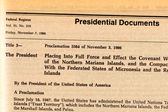
In June 1983 FSM voters approved the Compact of Free Association by 20,121 votes to 5,348, though Pohnpei voted no and most voters nationally chose independence on a fallback question. The Compact took effect in November 1986, giving the FSM self-government and its own foreign relations while the United States kept defense authority, and the FSM joined the United Nations in 1991. Three compacts have brought three eras of US funding, and visa-free entry to the US has drawn so many people away that the 2023 census counted about a quarter fewer people than in 2010.
-
Politics and society since 1979
, 1979–2026
The brief for Politics and society since 1979
The young federation built its own institutions, opening the FSM Supreme Court in 1981 and making Palikir the capital in 1989. President Tosiwo Nakayama vetoed a 1981 bill to make Chuuk’s Faichuk region a separate state, and Chuuk’s planned 2015 independence vote has been postponed again and again. After decades in which most proposed amendments failed, voters in July 2023 approved all nine on the ballot, including dual citizenship.
-
Recent years
, 2023–2026
The brief for Recent years
In May 2023 Congress chose Chuuk’s Wesley Simina as the tenth president, two months after his predecessor, David Panuelo, charged China with bribery in a letter. Compact III funding became US law in March 2024, but the money arrived late, and in 2025 the US Interior Department warned it could withhold funds over late FSM audits. In 2026 Super Typhoon Sinlaku struck Chuuk, and President Simina acknowledged a “possible setback” after a US admiral called the FSM’s $1.3 billion compensation demand for a Yap defense site unreasonable, though talks continued in August.
Some eras run side by side: the Trust Territory years overlap the road to nationhood, and free association runs alongside politics and society since 1979.