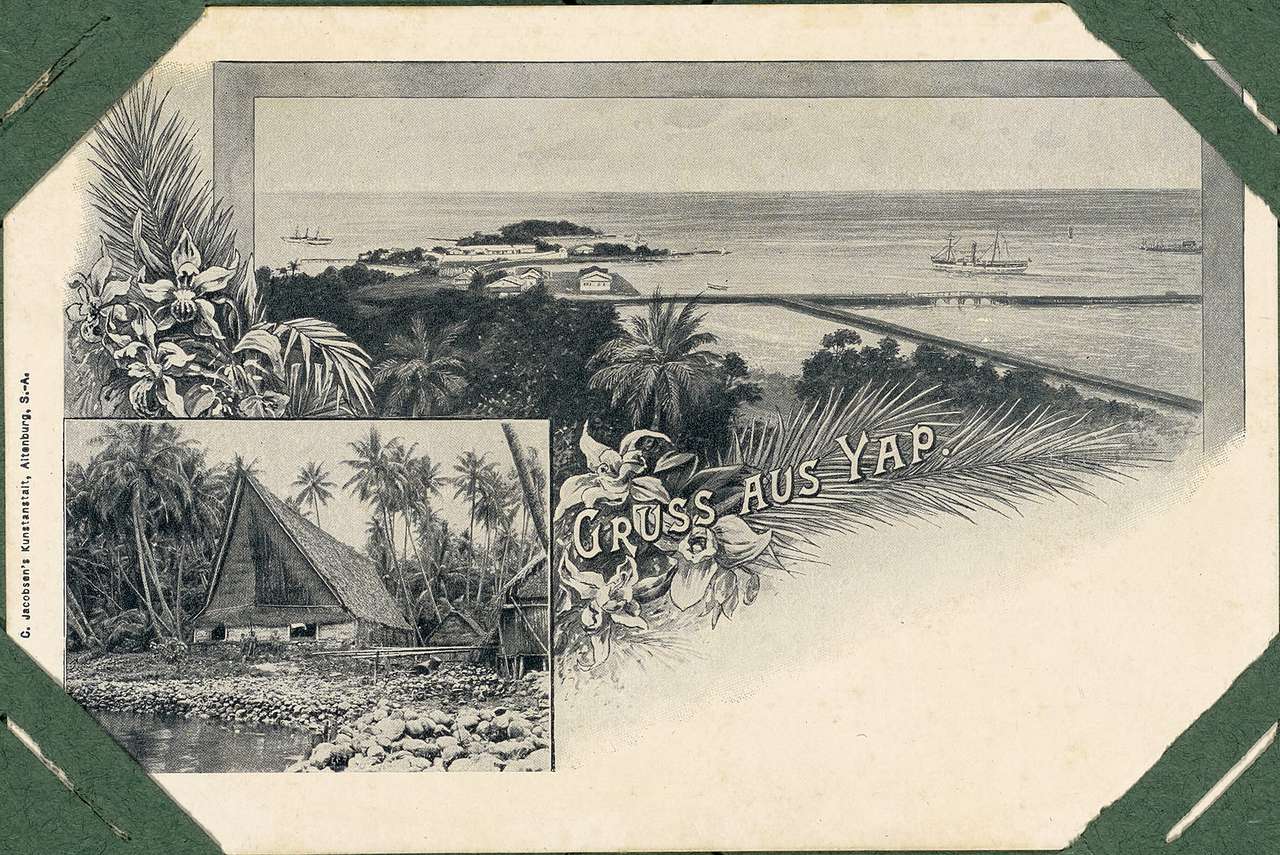
Germany ruled from Pohnpei and Yap under Rabaul
Germany took over Pohnpei on 12 October 1899, under the governorship of German New Guinea.11 Bundesarchiv, “Aufruhr auf Ponape” An imperial order of 18 July 1899 claimed possession. Handovers followed at Yap on 3 November and Saipan on 17 November.22 Kolonial-Lexikon; Spennemann
Yap became the seat of the Western Carolines, with a district officer, police officer and physician.33 Habele, “German Period” Germany’s stated priorities were pacification first, then copra.
A severe 1905 typhoon brought famine to Pohnpei, and residents traded many guns for food relief.44 Habele, “German Period” Another typhoon devastated Woleai in Yap’s outer islands in 1907. Disarmament stayed partial, which helps explain why the 1910 rebels were well armed.
A land reform turned tribute into state labor
Governor Hahl announced the “abolition of feudalism” on Pohnpei in 1907.55 Habele, “German Period” German sources date the end of feudal tenure to 1909–1910, and printed deeds to 1912.66 Kolonial-Lexikon, Ponape; Kilara v. Alexander
Administrator Georg Fritz made tenants landowners and replaced tribute with 15 unpaid days of government labor a year. The 15-day rule appears only in English secondary sources.77 Wikipedia, Sokehs
His successor, Gustav Boeder, refused to honor Fritz’s deal waiving Sokehs’s 1909 labor.88 Habele, German Period No German text found attests that waiver.
The Sokehs Rebellion became a national memory
On 17 October 1910, Boeder ordered a Sokehs road worker flogged.99 Bundesarchiv The next day the gang revolted and killed Boeder, three other Germans and several boatmen. The 1911 Navy account lists Boeder, two officials and five Pohnpeians.1010 Gartzke 1911, NLA
The leader was Soumadau en Sokehs, baptized Samuel, described via Riesenberg as a lower-ranking section chief.1111 Wikipedia, Sokehs rebellion German files call him “Jomatau (Somadau en Sokehs)” and record little about him.1212 Bundesarchiv
The revolt was not pan-Pohnpeian at the time. Only Palikir joined Sokehs, while Net, U, Madolenihmw and Kitti backed the Germans.1313 Pohnpei-adventure.com The 1920 Kolonial-Lexikon calls Palikir Sokehs’s “vassal state” and says its people were banished to Palau with Sokehs.1414 Kolonial-Lexikon, Ponape
The other paramountcies offered about 600 warriors to defend Kolonia.1515 Wikipedia, Sokehs rebellion
Germany sent the cruisers Emden, Nürnberg and Cormoran, the survey ship Planet and Melanesian police.1616 Bundesarchiv; Gartzke 1911, NLA They shelled the Sokehs ridge on 13 January 1911 and burned rebel food supplies. Samuel surrendered on 13 February, and the last fighters gave up by 22 February.
Fifteen men were shot in Kolonia on 24 February 1911.1717 Bundesarchiv Morlang counts 17 death sentences; the Bundesarchiv counts 15.1818 Morlang; Wikipedia, citing Morlang The “17 executed” of MicSem and Habele has no German support.1919 MicSem
Today 24 February is an FSM holiday, and the mass grave is a national shrine.2020 MicSem
Germany deported the remaining Sokehs people via Yap to Palau. The 1920 Kolonial-Lexikon gives 426, the German figure of record, while MicSem says 460.2121 Kolonial-Lexikon; Bundesarchiv; Habele; MicSem
About 50 exiles died and over 100 men worked Angaur’s phosphate mines.2222 Bundesarchiv Germany declared Sokehs government land and leased it to Pohnpeians from other districts. Mortlockese and other outer islanders also settled there from 1912.2323 Bundesarchiv; Riesenberg 1968
Germany also catalogued and collected
The Hamburg South Seas Expedition ran from 1908 to 1910. Its Micronesian year, 1909–1910, led by Augustin Krämer, recorded Pohnpei, Chuuk, Kosrae, Yap and Palau.2424 Habele, HOM vol. 40; Krämer-Bannow 1916 It documented genealogies, canoes, navigation and Nan Madol, and gathered objects now in German museums.
The expedition gathered over 12,000 objects in all.2525 Tiefgang German Capuchins and Protestant Liebenzell missionaries expanded church work in this period.2626 APIC, Hezel lecture