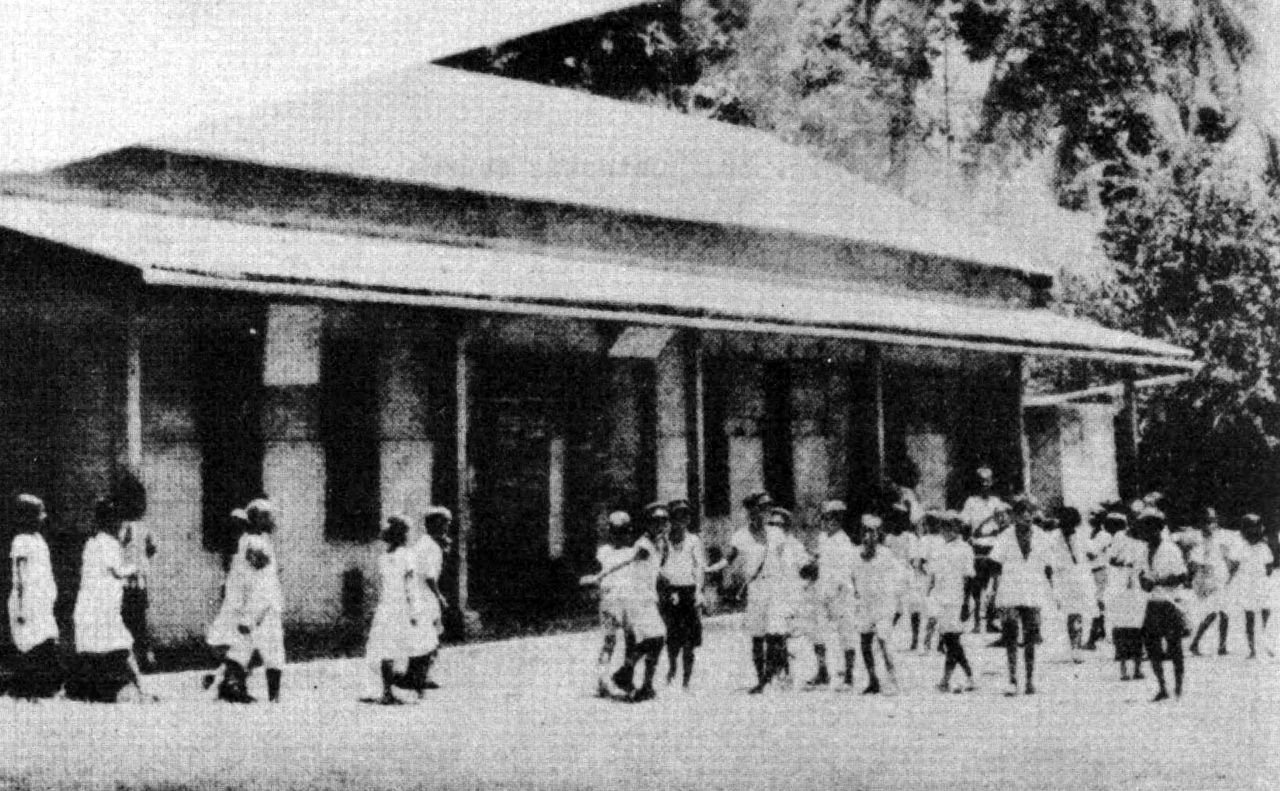
Settlers came in numbers, mostly to Pohnpei and Chuuk
Japanese traders had worked in Chuuk since 1890, including Koben Mori, great-grandfather of later president Manny Mori.99 APIC, Hezel lecture Most settlers before 1930 were Okinawans, often single fishermen.1010 Wikipedia, Japanese Micronesians
By 1941, Japanese residents may have slightly outnumbered locals around Kolonia and Palikir. That claim comes from a 1950 US National Research Council study, via Wikipedia; no Japanese table confirms it.1111 Wikipedia, Japanese Micronesians
Kosrae stayed lightly settled, with 25 Japanese among 1,189 Kosraeans in 1935. By 1945 the central and eastern Carolines held 14,066 Japanese, Okinawan and Korean civilians plus about 8,000 troops.1212 Wikipedia, citing Poyer et al.
A tourism site claims 14,000 Japanese on Pohnpei alone, which likely conflates the regional total.1313 Pohnpei-adventure.com Japan’s official archive gives about 5,600 Japanese on Pohnpei at war’s end.1414 JACAR, Ponape
The colony paid for itself
Hezel notes the islands were self-supporting before the war, which no later government achieved.1515 APIC, Hezel lecture Tuna and dried-bonito plants ran on Chuuk and Pohnpei, and Pohnpei’s cannery opened in 1930.
By 1937 at least 1,500 Okinawans and Japanese worked in the mandate’s fishing industry.1616 Wikipedia, Japanese Micronesians Okinawans on Pohnpei numbered 1,145, mostly in fishing and farming.1717 Ryukyu Shimpo
A farming commune of 24 families started at Palikir in 1931, and the market town of Haruki rose nearby.1818 Wikipedia, Japanese settlement in the FSM Japanese records list Haruki as a government settlement and local center by 1936.1919 Miyauchi 2018
These settlements sat partly on Sokehs-area land Germany had confiscated. That link is an inference; none of the sources used here states it.
Schools taught obedience; churches were welcomed
Islanders got a three-year course at one of about two dozen public schools, with a two-year supplement at branch seats.2020 Hashimoto; APIC, Hezel lecture Critics note the system stressed obedience and trained islanders only for low-level jobs.2121 TIGHAR Japan invited Spanish Jesuits, Japanese Congregational pastors and German Liebenzell missionaries.
Withdrawal from the League led to fortification
Japan quit the League in 1933 and signaled it would keep the islands.2222 TIGHAR From the mid-1930s the Navy took control of facility siting. On Pohnpei, the Palikir and Sekere hills were fortified with trenches, pillboxes and guns.2323 Pohnpei-adventure.com