FSM History

Chapter 5 of 10

World War II, 1941–1945

Chuuk Lagoon was a Japanese fleet base until February 1944, when US carrier planes wrecked it, and the US then bypassed the islands, so none of the four was invaded. Chuukese remember the war mostly through food shortages, and Yapese through bombing, labor drafts and “suffering.” After the surrenders of September 1945, almost all Japanese settlers were sent home, though children of mixed families stayed.

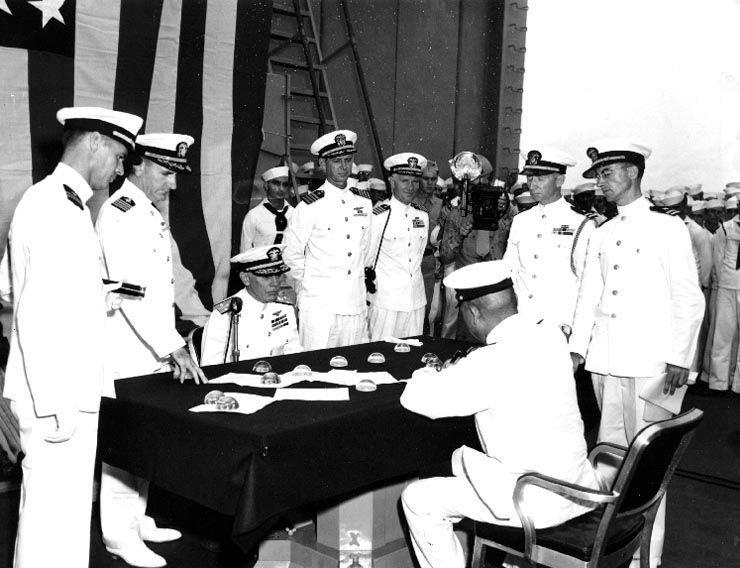
Black-and-white photograph on board a warship. A Japanese officer, seen from behind, signs papers at a cloth-covered table; a US admiral sits facing him, and US Navy officers in white uniforms stand around the table in front of a large US flag.Open the full image, without the site’s colour treatment

Photo not loaded, to save data.

Vice Admiral Chuichi Hara, commander of Japan’s 4th Fleet, signs the surrender of the base at Truk (Chuuk) aboard USS Portland, 2 September 1945.

U.S. Navy photograph NH 62802, Naval History and Heritage Command (Collection of Fleet Admiral Chester W. Nimitz), via the HyperWar mirror of the Naval Historical Center Online Library.

In this chapter 8 parts

Truk was a fleet base until February 1944

Chuuk Lagoon served as the Combined Fleet’s forward anchorage until a US reconnaissance flight on 4 February 1944.1 NHHC, H-Gram 026-3 Admiral Koga then pulled the fleet back, mostly to Palau. Operation Hailstone struck on 17–18 February 1944 with over 500 US carrier aircraft.

The raid sank two light cruisers, four destroyers and 30 auxiliaries and merchant ships, plus smaller warships.2 NHHC Japanese tallies add a third light cruiser, Agano, sunk by a US submarine.3 ja.wikipedia

It destroyed 250–275 of about 365 Japanese aircraft, while the US lost 25 aircraft and 40 men.4 NHHC On 12 March 1944 Nimitz decided to bypass Truk.

Bypassed islands faced hunger, labor and bombing

About 38,700 Japanese army and navy personnel, later repatriated from Truk in 1945–46, shared Chuuk Lagoon with about 10,000 Chuukese until the surrender.5 Poyer, “Dimensions of Hunger,” via Habele; ja.wikipedia, Chuuk Most civilians had left by May 1944.6 JACAR, Truk

Chuukese memories center on food shortages. In the final months the military took breadfruit and other food from Micronesian farms.7 Wikipedia, citing Poyer et al.

US aircraft bombed Pohnpei from February 1944 to February 1945.8 Pacific Wrecks Japanese sources date the first raid to 15 February 1944, with heavy raids through May.9 ja.wikipedia, Pohnpei

Kolonia burned, crops were destroyed, and survivors sheltered in caves.10 Pohnpei-adventure.com A 1944 airfield stood where the national government complex at Palikir now sits.

Yapese recall the war through bombing, labor drafts and “suffering,” and some war-claims disputes remain open.11 Poyer, “Yapese Experiences,” via Habele Kosrae held about 4,500 Japanese troops under Lt. Gen. Yoshikazu Harada.12 Wikipedia, Kosrae; Last Stand on Zombie Island No source yet covers Kosraean hunger or labor.

None of the four islands was invaded, so the war there meant siege rather than ground combat.

Surrender emptied the islands of settlers

Truk’s commanders surrendered aboard USS Portland on 2 September 1945.13 NHHC photo archive, via ibiblio Lt. Gen. Mugikura Shunzaburō signed at Truk. Kosrae surrendered on 8 September aboard USS Hyman, and Pohnpei on 11 September.14 ja.wikipedia, Chuuk; JACAR, Ponape; Zombie Island

Almost every Japanese settler was repatriated, and only 33 in the central and eastern Carolines stayed.15 Wikipedia, citing Peattie and Poyer Children of mixed families stayed; a claim that 20% of citizens have Japanese ancestry is weakly sourced.

Key events

  1. 194115 Jan
    Chuuk

    The Navy’s 4th Signal Unit is formed under the Truk-based 4th Base Force.

    Source: JACAR, 4th Base Force

  2. 1942Jun
    National

    Last territory-wide count: 86,810 Japanese against 51,951 islanders.

    Source: Miyauchi 2018

  3. 1943
    Chuuk

    Chuuk is strongly garrisoned; about 38,000 outsiders and 10,000 Chuukese face growing hunger through 1945.

    Source: Poyer, “Dimensions of Hunger” (Habele)

  4. 194417–18 Feb
    Chuuk

    Operation Hailstone: 500+ US carrier aircraft strike Truk, destroying 250–275 of about 365 Japanese aircraft.

    Source: NHHC, H-Gram 026-3

  5. 194430 Mar
    Yap Outer islands

    A US raid wrecks the Asor weather station; the Japanese then remove 84 men and 15 women from Ulithi.

    Source: Habele, Ulithi

  6. 1944Apr
    Yap Outer islands

    About 7,000 Japanese soldiers arrive to defend Woleai and its airfield.

    Source: Habele, Woleai

  7. 194420 Sep (or 21–23 Sep)
    Yap Outer islands disputed

    US forces occupy Ulithi without opposition, guided by men from Federai.

    Source: Pacific Wrecks, Ulithi Habele, Ulithi

  8. 194514–15 Jun
    Chuuk

    British Pacific Fleet aircraft and cruisers attack Truk in Operation Inmate.

    Source: Wikipedia, Operation Inmate

  9. 194512 Oct
    Yap

    Repatriation of Japanese from Yap begins; it is completed by March 1946.

    Source: JACAR, Yap branch

  10. 1945
    Pohnpei Kosrae Chuuk

    The central and eastern Carolines hold 14,066 Japanese, Okinawan and Korean civilians plus about 8,000 troops.

    Source: Wikipedia, Japanese settlement in the FSM

All 50 events from these years in the timeline

People

No individual figures are profiled for this era yet.

Where sources disagree in this era

No contested dates or figures are recorded for this era.

Every contested fact, in one table

Through other eyes

Records from the time in other languages, each shown in the original beside an English translation, with what it settles.

The war and the surrendersJapanese records, 4 sources

神立尚紀 (Koudachi Naoki), 現代ビジネス, 17 February 2019, citing 戦史叢書, 神立尚紀 (Koudachi Naoki)

Original, Japanese:

「この両日の空襲で撃沈された日本側艦船は、艦艇10隻、船舶33隻にのぼり、そのほか12隻の艦船が損傷した。」

English translation:

“Japanese vessels sunk in the two days’ raids came to 10 naval vessels and 33 merchant ships, with 12 more damaged.”

What it settles: Japanese tallies broadly match NHHC. Via Japanese Wikipedia’s 戦史叢書 citations, they count three light cruisers, including Agano, sunk by a US submarine (ja.wikipedia).

JACAR glossary, “ポナペ支庁,” JACAR

Original, Japanese:

「…1945年9月11日に降伏調印がおこなわれ、12月から1946年1月の間に内地帰還を果たした。」

English translation:

“…the surrender was signed on 11 September 1945, and [the Japanese] returned home between December and January 1946.”

What it settles: Pohnpei surrendered on 11 September 1945, not with Truk on 2 September.

JACAR glossary, “トラック支庁/東部支庁,” JACAR

Original, Japanese:

「1944年5月頃までに東部支庁管内の民間邦人は内地に引き揚げた。」

English translation:

“By around May 1944 the Japanese civilians within the Eastern Branch’s jurisdiction had returned to the home islands.”

What it settles: many civilians left during the war, not only after it. This sits uneasily with JACAR’s own 5,600 Japanese on Pohnpei in 1945.

JACAR glossary, “ヤップ支庁,” JACAR

Original, Japanese:

「10月12日から邦人の内地送還が始まり、1946年3月までに終了した。」

English translation:

“Repatriation of Japanese to the home islands began on 12 October and was completed by March 1946.”

What it settles: the US occupied Yap on 2 September 1945, and its Japanese left between October 1945 and March 1946.

Summary (not a quote): Japanese Wikipedia, citing 日置英剛 (2005), says Lt. Gen. 麦倉俊三郎 (Mugikura Shunzaburō) signed Truk’s surrender. It says 14,173 army and 24,524 navy men returned from Truk between November 1945 and February 1946 (ja.wikipedia).

All Japanese records in Through other eyes

All foreign-language records

Notes

  1. NHHC, H-Gram 026-3 ↑
  2. NHHC ↑
  3. ja.wikipedia ↑
  4. NHHC ↑
  5. Poyer, “Dimensions of Hunger,” via Habele; ja.wikipedia, Chuuk ↑
  6. JACAR, Truk ↑
  7. Wikipedia, citing Poyer et al. ↑
  8. Pacific Wrecks ↑
  9. ja.wikipedia, Pohnpei ↑
  10. Pohnpei-adventure.com ↑
  11. Poyer, “Yapese Experiences,” via Habele ↑
  12. Wikipedia, Kosrae; Last Stand on Zombie Island ↑
  13. NHHC photo archive, via ibiblio ↑
  14. ja.wikipedia, Chuuk; JACAR, Ponape; Zombie Island ↑
  15. Wikipedia, citing Peattie and Poyer ↑
Cite this page
APA Chicago Link