FSM History

Chapter 2 of 10

Spanish rule, 1886–1899

After Pope Leo XIII mediated between Spain and Germany in 1885, Spain ruled the Caroline Islands from two small posts, on Yap and at Kolonia on Pohnpei. Pohnpeians fought three wars under Spanish rule: Sokehs and Net men destroyed a Spanish column in 1887, Madolenihmw fighters killed a detachment at Ohwa in 1890, and in 1898 a war at Awak split the island along church and chiefdom lines. Spain took no part in the copra trade and did not try to run Kosrae’s internal affairs, and after losing its 1898 war with the United States it sold the islands to Germany.

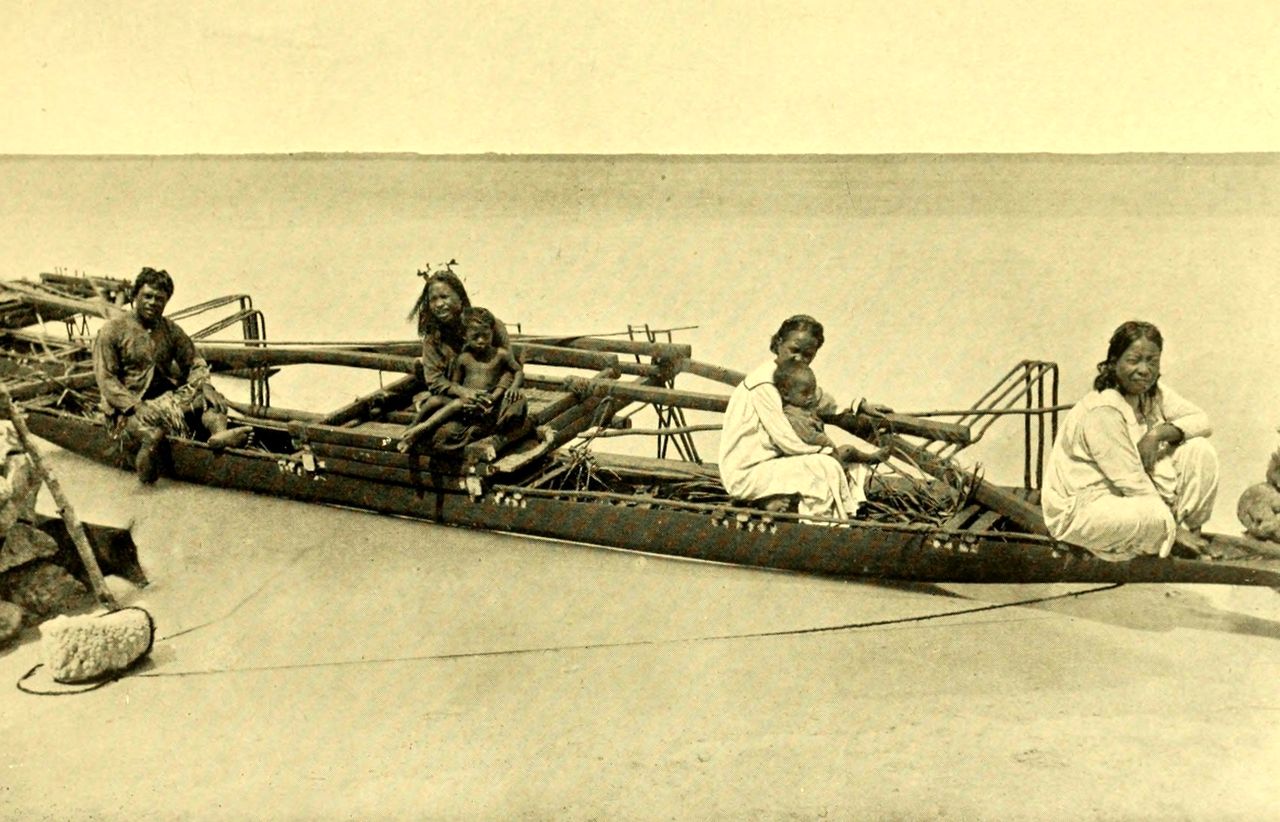
Photograph of a long outrigger canoe drawn up on a sandy beach with the open sea behind. One adult sits near the far end, a girl with a flower in her hair holds a small child on the outrigger platform, and two women in long white dresses sit along the hull, one with a baby in her arms.Open the full image, without the site’s colour treatment

Photo not loaded, to save data.

“A Paliker fishing-canoe”: a Palikir canoe on Pohnpei, photographed in the 1890s and published in 1899.

F. W. Christian, The Caroline Islands: Travel in the Sea of the Little Lands (New York: Scribner’s, 1899), plate facing p. 70. Photographer not named. Internet Archive, from Boston University School of Theology Library.

In this chapter 9 parts

A German flag on Yap triggered papal mediation

Spanish ships reached Yap on 21–22 August 1885 to found a colony.1 Habele Institute, “Yap Conflict” Before their ceremony, the German gunboat Iltis landed and raised the German flag. Habele dates this to 25 August, Wikipedia to 2 August; 25 August fits the Spanish arrival sequence and is better supported.

The news set off riots in Madrid and a rally of over 30,000 people.2 Wikipedia, Carolines Question That crowd size rests on English Wikipedia; the Spanish article gives no size.3 es.wikipedia, Crisis de las Carolinas

Bismarck proposed Leo XIII as mediator. The Pope’s proposal of 22 October 1885 affirmed Spanish sovereignty and guaranteed German trade and settlement rights.4 Gaceta de Madrid; Cum de Carolinis Germany won freedom to trade and settle, confirmed in a protocol signed in Rome on 17 December 1885 and published in Madrid on 10 January 1886.5 Gaceta de Madrid

Spain governed from two small outposts

Spain ran the Western Carolines from Yap, where Governor Manuel Elisa Vergara arrived in 1886.6 COM-FSM, “Government Administration”; COM-FSM timeline The Capuchin mission landed there on 29 June 1886.7 Valencina 1917

Pohnpei became the seat of the Eastern Carolines, which included Chuuk and Kosrae. Spain took no part in the copra trade, which German firms dominated.8 Valencina 1917

Kosrae saw “no attempt to govern” its internal affairs.9 Kosrae outline The sources used here don’t document any Spanish post in Chuuk. In practice the Spanish era is mainly a Pohnpei story, with Yap second.

On Yap, Spain kept a garrison and Capuchin missions but interfered little.10 Habele, “Yap Conflict” Officials criticized traders like O’Keefe yet relied on him for supplies and ships.11 Hezel, O’Keefe One Wikipedia citation says Spain also used Yap to hold Philippine Revolution prisoners.12 Wikipedia, Yap

Pohnpei fought Spain three times

Governor Isidoro Posadillo (one Spanish source gives José) landed on 14 March 1887 with 50 soldiers, 50 Filipino convicts and six Capuchins.13 MicSem Catholic history; Navy biography; MicSem; Cabello He named the colony Santiago de la Ascensión, today’s Kolonia. Within a month he deported the American missionary Edward Doane to Manila.

Forced labor sparked a strike in July 1887. On 1 July men of Sokehs and Net wiped out a column of 20–24 men under alférez Martínez.14 Moya 1891; Cabello Moya says half its soldiers deserted to the attackers.

On the night of 3–4 July, Posadillo and others died trying to reach a hulk offshore.15 Spanish biographical source, PDF Moya (1891) gives dawn on 5 July.16 Moya 1891

Relief arrived on 31 October 1887, when the San Quintín returned with new governor Luis Cadarso.17 Cabello; Moya 1891; MicSem The “1 September” date belongs to the 1890 expedition.

In 1890 Governor Cadarso pushed a fort and church at Ohwa, beside the Protestant mission in Madolenihmw.18 MicSem Catholic history One Spanish Navy source instead places Cadarso in the Western Carolines in 1887–1890.19 Revista General de Marina 2025; Cabello

On 25 June 1890 Madolenihmw fighters killed Lt. Marcelo Porras’s detachment.20 Moya 1891; Cabello Moya counts 28 dead, Habele 33 and Cabello 34.21 Habele, “Pohnpei Rebellion”

Cabello counts 118 Spanish dead and 87 wounded across 1887–1890; MicSem ties 118 to 1890.22 Cabello; MicSem The 200,000-peso cost is unconfirmed; Cabello gives 14,110.82 pesos.

Spain blamed the Protestants and had an American warship remove their missionaries. In March 1898 Mwahnd, backed by Madolenihmw and U, attacked Catholic Awak.23 MicSem Catholic history The later 900-man force came from Kitti, U and Madolenihmw.

Net and Sokehs fought alongside Spain, which shows how church rivalry had become a proxy for chiefdom rivalry. A 27-man Spanish garrison was besieged at Awak until news of peace arrived. The gunboat Quirós helped save the mission.24 Cabello; MicSem

Spain sold the islands after losing to the US

After the 1898 war, Spain sold the Carolines, Palau and the Northern Marianas to Germany.25 Wikipedia, German–Spanish Treaty A secret accord (10 December 1898) and a declaration (12 February 1899) preceded the law of 24 June. The treaty was signed in Madrid on 30 June 1899.26 Pozuelo 1998; Gaceta, 29 Jun 1899; Fitzner 1901

The price was 25 million pesetas, equal to 16.75 million marks.27 Gaceta, 13 Jun 1899; Kolonial-Lexikon; COM-FSM Habele’s 24 million is wrong.28 Habele

Key events

  1. 188526 Feb
    Yap

    The Spanish ship Velasco (Butrón) makes an exploratory voyage to Yap, gathering ethnographic data.

    Source: MicSem ship list: Yap

  2. 1886Early Apr
    National

    The first Capuchin friars leave Spain for the Carolines.

    Source: MicSem, Catholic Church: Pohnpei

  3. 188720 Jul
    Yap

    The new Guror church is dedicated to San Francisco.

    Source: MicSem, Catholic Church: Yap

  4. 1889Mar
    Yap

    A quake (MicSem 2072: “volcanic eruption”) at Lamer lasts about three months; an anti-missionary prophetic movement follows.

    Source: MicSem, Catholic Church: Yap MicSem, Spanish Capuchins

  5. 1890
    Pohnpei

    Spain counts 118 dead and 87 wounded from Pohnpeian revolts across 1887–1890 (MicSem ties 118 to 1890 alone).

    Source: Cabello Berdún 2023 MicSem, Catholic Church: Pohnpei

  6. 1892Feb
    Pohnpei

    The new colony school is dedicated; enrollment reaches 30.

    Source: MicSem, Catholic Church: Pohnpei

  7. 1894
    Yap

    The Guror church is rebuilt and a cross raised over the Matsebap cult site.

    Source: MicSem, Spanish Capuchins

  8. 1898Mar
    Pohnpei

    Mwahnd forces, backed by Madolenihmw and U, attack Catholic Awak; cruiser Quirós briefly arrests Henry Nanpei.

    Source: MicSem, Catholic Church: Pohnpei Cabello Berdún 2023

  9. 1899May
    Pohnpei

    The España brings an interim governor, the last of 12 Spanish administrators on Pohnpei.

    Source: MicSem, Catholic Church: Pohnpei

  10. 1899
    Kosrae

    German rule over Kosrae begins, lasting until 1914.

    Source: Kosrae history outline

All 92 events from these years in the timeline

People

Isidoro Posadillo
First Spanish governor of the Eastern Carolines at Pohnpei; killed in the July 1887 uprising.
Pohnpeian leaders in Spanish records
Spanish army accounts name Chaulik (killed), Kronniletan, Tog, Nampig, Nalam, Krown Chapalap, Tok Herú, “rey Not” and Pablo of Madolenihmw. These are Spanish spellings and some may be titles rather than names; they need checking by Pohnpeian speakers.

Where sources disagree in this era

  • German flag on Yap

    25 Augor2 Aug 1885

    Better supported 25 August (fits Spanish arrival) Source not yet linked

  • Posadillo’s first name

    Isidoro, Isidro or José

    Better supported Isidoro (two sources) (Navy biography; MicSem; Cabello)

  • Posadillo’s death

    3–4 Julyor5 July 1887

    Better supported 3–4 July (two sources) (Navy biography; Cabello; Moya 1891)

  • Ohwa dead, June 1890

    28or33or34

    Unresolved about 30 (Moya 1891; Cabello)

  • Spanish war cost, 1887–1890

    200,000or14,110.82 pesos

    Unresolved (Cabello)

  • 1890 expedition colonel

    Gutiérrez SotoorPérez de Soto

    Unresolved (Moya 1891; Cabello)

  • 1899 German–Spanish declaration

    12or8 February 1899

    Unresolved (Pozuelo 1998; Kolonial-Lexikon)

  • Price of 1899 sale

    25 millionor24 million pesetas

    Better supported 25 million pesetas (16.75 million marks) (Kolonial-Lexikon)

  • Kosrae’s low point

    ~300 by c.1890orunder 200 by 1880

    Better supported Hezel’s ~300, with uncertainty (Hezel, “Disease in Micronesia”; Kosrae outline)

Every contested fact, in one table

Through other eyes

Records from the time in other languages, each shown in the original beside an English translation, with what it settles.

The 1885 crisis and the Rome protocolSpanish records, 3 sources

Gaceta de Madrid, no. 10, “Protocolo entre España y Alemania sobre las Carolinas y Palaos,” 10 January 1886, pp. 77–78, BOE PDF

Original, Spanish:

«PROPOSICIÓN HECHA POR SU SANTIDAD EL PAPA LEÓN XIII, COMO MEDIADOR»

English translation:

“Proposal made by His Holiness Pope Leo XIII, as mediator.”

Original, Spanish:

«Se afirma la soberanía de España sobre las islas Carolinas y Palaos.»

English translation:

“Spain’s sovereignty over the Caroline and Palau islands is affirmed.”

Original, Spanish:

«El Gobierno alemán reconoce la prioridad de la ocupación española de las islas denominadas Carolinas y Palaos»

English translation:

“The German Government recognises the priority of the Spanish occupation of the islands called the Carolines and Palaus.”

Original, Spanish:

«Hecho en Roma á 17 de Diciembre de 1885.»

English translation:

“Done at Rome, 17 December 1885.”

What it settles: Leo XIII acted as mediator, not arbitrator. His proposal is dated 22 October 1885 in the section heading, and the protocol was signed in Rome on 17 December 1885. Its limits ran from the Equator to 11° N and from 133° to 164° E.

Wikipedia (Spanish), “Crisis de las Carolinas,” citing Seco Serrano, Alfonso XII (2007), pp. 211–212, Wikipedia (Spanish): Crisis de las Carolinas

Original, Spanish:

«El 21 de agosto y el 22, respectivamente, llegaron a Puerto Tomil (actual Yap) el San Quintín y el Manila.» … «fondeó el día 25, a las 5:20 de la tarde, el Iltis.»

English translation:

“On 21 August and the 22nd, respectively, the San Quintín and the Manila arrived at Port Tomil (present-day Yap) … the Iltis anchored on the 25th, at 5:20 in the afternoon.”

What it settles: the arrival sequence supports 25 August 1885 for the German flag on Yap, not 2 August. This page gives no crowd size for the Madrid protests, so the “over 30,000” figure still rests on English Wikipedia.

Ambrosio de Valencina, Mi viaje a Oceanía (Sevilla, 1917 ed.), Internet Archive OCR

Original, Spanish:

«el día de San Pedro del mismo Junio de 1886»

English translation:

“on Saint Peter’s day of that same June 1886.”

What it settles: Capuchins reached Yap on 29 June 1886. That is the same date the doc gives for Yap’s first Spanish governor, and MicSem agrees (MicSem).

All Spanish records in Through other eyes

Pohnpei, 1887: the first warSpanish records, 4 sources

Francisco J. de Moya, Nuestro ejército en las Carolinas, Memorial de Artillería (Madrid, 1891), Internet Archive OCR

Original, Spanish:

«que si el Gobernador era Gobernador, ellos eran allí los reyes, que podían más»

English translation:

“that if the Governor was Governor, they were the kings there, who held more power.”

Original, Spanish:

«sólo con 12 hombres, se batió cuerpo á cuerpo»

English translation:

“with only 12 men, [he] fought hand to hand.”

Original, Spanish:

«el bravo capitán Posadillo, herido mortalmente en el pecho con cuatro balazos … sucumbiendo al fin á los golpes de maza de los infieles»

English translation:

“the brave captain Posadillo, mortally wounded in the chest by four bullets … finally succumbing to the club blows of the infidels.”

What it settles: the strike began on 30 June 1887 and alférez Martínez led 24 men toward Sokehs. Moya says 12 punishment-battalion soldiers went over to the attackers. He puts Posadillo’s death at dawn on 5 July, a day later than other sources.

Fernando González de Canales, “Un inexplicable (y subsanable) olvido,” Madrid, 2002, pp. 2–3, PDF

Original, Spanish:

«Dile a quien te manda, que si él es gobernador de la colonia yo soy [rey]…»

English translation:

“Tell whoever sends you that if he is governor of the colony, I am [king]…”

What it settles: this Navy biography names the governor “Isidoro Posadillo y Posadillo,” not “Isidro.” It dates his death to the night of 3–4 July 1887. Its “1 September 1887” relief date is likely a mix-up with the 1890 expedition.

Santiago Cabello Berdún, “Las guerras Kanakas: Fin de la Oceanía española,” Guerra Colonial 13 (2023), pp. 52–66, PDF

Original, Spanish:

«El 31 de octubre, con intención de hacer un alarde [de] fuerza entre los nativos, regresó el San Quintín»

English translation:

“On 31 October, intending to make a show of force among the natives, the San Quintín returned.”

What it settles: the 1887 relief came on 31 October, with new governor Luis Cadarso. This matches MicSem’s “end of October” (MicSem). Cabello calls the governor “José Posadillo,” a third variant; “Isidoro” has two sources and is better supported.

Queen Regent’s speech opening the Cortes, 1 December 1887, reprinted in Boletín Oficial de la Provincia de las Baleares, 8 December 1887, Prensa Histórica

Original, Spanish:

«para hacer respetar nuestra bandera en la isla de Ponapé»

English translation:

“to make our flag respected on the island of Ponapé.”

What it settles: Spain’s crown treated the 1887 Pohnpei defeat as a national matter within months.

All Spanish records in Through other eyes

The Ohwa war, 1890Spanish records, 2 sources

Cabello Berdún (2023), section “Segundo enfrentamiento,” PDF

Original, Spanish:

«El 25 de junio, rebeldes bajo las órdenes de los líderes tribales Krown Chapalap y Tok Herú de los Metalanim…»

English translation:

“On 25 June, rebels under the orders of the tribal leaders Krown Chapalap and Tok Herú of the Metalanim [Madolenihmw]…”

Original, Spanish:

«Después de tres años, desde 1887 a 1890, las revueltas kanakas habían causado 118 muertos y 87 heridos»

English translation:

“After three years, from 1887 to 1890, the Kanaka revolts had caused 118 dead and 87 wounded.”

What it settles: the Ohwa attack fell on 25 June 1890 and killed 34 by Cabello’s itemized count. The 118 dead cover 1887–1890 together, not 1890 alone. Cabello also gives the cost as 14,110.82 pesos, with no period stated, against MicSem’s “nearly 200,000 pesos.”

Moya (1891), Internet Archive OCR

Original, Spanish:

«El teniente Porras, que mandaba el destacamento, y 27 individuos más de tropa, fueron sorprendidos … y asesinados bárbaramente por la tribu de Metalanim.»

English translation:

“Lieutenant Porras, who commanded the detachment, and 27 more enlisted men were surprised … and barbarously murdered by the Metalanim tribe.”

Original, Spanish:

«al mando del coronel de infantería don Isidro Pérez de Soto» … «El 1.º de septiembre llegaba la expedición á la isla de Ponapé»

English translation:

“under the command of infantry colonel Don Isidro Pérez de Soto … On 1 September the expedition arrived at the island of Ponapé.”

What it settles: Moya counts 28 dead at Ohwa, against Cabello’s 34 and Habele’s 33. The “1 September” arrival belongs to the 1890 relief, not 1887. Moya’s colonel is “Pérez de Soto,” while most literature says Gutiérrez Soto.

Summary (not a quote): Moya names Pohnpeian fighters at Ohwa. Chief “Chaulik” was killed, and “Kronniletan, Tog, Nampig, Nalam” were wounded. He claims over 100 enemy casualties at Ohwa and about 200 at Ketam, figures from a partisan army account.

All Spanish records in Through other eyes

Awak, 1898Spanish records, 2 sources

Cabello Berdún (2023), section “Cuarto enfrentamiento: marzo de 1898,” citing AHN Ultramar 5353, exp. 7, PDF

Original, Spanish:

«en Atuak, quedaron solo veintisiete soldados al mando del segundo comandante del Villalobos»

English translation:

“at Atuak only twenty-seven soldiers remained, under the command of the second-in-command of the Villalobos.”

What it settles: the Awak (“Atuak”) fighting began in March 1898. A 27-man Spanish garrison was besieged until German ships brought news of peace. Cabello says the “king of Not” (Net) wanted everyone converted to Catholicism.

Juan Escrigas Rodríguez, Revista General de Marina, November 2025, p. 933, PDF

Original, Spanish:

«En las Carolinas: los cañoneros Quirós…»

English translation:

“In the Carolines: the gunboats Quirós…”

What it settles: the gunboat Quirós was on station in 1898, matching MicSem’s account that it saved the Awak mission (MicSem). The same article places Cadarso in the Western Carolines in 1887–1890, which conflicts with other sources.

All Spanish records in Through other eyes

The 1899 sale to GermanySpanish records, 3 sources

Gaceta de Madrid, no. 164, 13 June 1899, p. 903, BOE PDF

Original, Spanish:

«El Imperio alemán indemnizará la cesión de los territorios supradichos mediante la suma de 25 millones de pesetas»

English translation:

“The German Empire shall compensate the cession of the aforesaid territories by means of the sum of 25 million pesetas.”

What it settles: the price was 25 million pesetas. Habele’s 24 million is wrong.

Gaceta de Madrid, no. 180, 29 June 1899, p. 1151, BOE PDF

Original, Spanish:

«Dado en Palacio á veinticuatro de Junio de mil ochocientos noventa y nueve»

English translation:

“Given at the Palace on the twenty-fourth of June, eighteen ninety-nine.”

What it settles: the law authorizing the sale is dated 24 June 1899 and was published on 29 June. It excludes Guam and guarantees Spanish missions and firms equal treatment.

Belén Pozuelo Mascaraque, “Los Estados Unidos, Alemania y el desmantelamiento colonial español en el Pacífico,” Anales de Historia Contemporánea 14 (1998), pp. 161–165, PDF

Original, Spanish:

«por veinticinco millones de pesetas»

English translation:

“for twenty-five million pesetas.”

What it settles: a secret accord (10 December 1898) and a declaration (12 February 1899) came first. The treaty was signed in Madrid on 30 June 1899. Pohnpei was handed over on 12 October 1899, Yap was due on 3 November and Saipan followed on 17 November.

All Spanish records in Through other eyes

Population estimates and mission recordsSpanish records, 1 source

Juan Gualberto Gómez, Las Islas Carolinas y las Marianas (Madrid, 1885), Internet Archive OCR

Original, Spanish:

«La poblacion de Bonebey se calcula en unos 6.000 habitantes»

English translation:

“The population of Bonebey [Pohnpei] is reckoned at about 6,000 inhabitants.”

What it settles: nothing firm. These are 1885 compilations, not counts, and Gómez’s “about 3,000” for Yap is far below other estimates.

Summary (not a quote): Capuchin Fr. Agustín M.ª de Arínez compiled a Diccionario hispano-kanaka (1892) with over 3,500 Pohnpeian entries. A copy is at Spain’s National Library, shelfmark HA/9974 (BVFE).

All Spanish records in Through other eyes

Yap, August 1885German records, 2 sources

German Wikipedia (mirror), “Karolinenfrage,” citing Boelcke, So kam das Meer zu uns (1981), dewiki

Original, German:

„Als am Abend des 25. August 1885 das deutsche Kanonenboot Iltis in den Hafen von Yap einlief“ … „Dennoch ließ Hofmeier die deutsche Flagge hissen“

English translation:

“When on the evening of 25 August 1885 the German gunboat Iltis entered Yap harbour … Nevertheless Hofmeier had the German flag hoisted.”

What it settles: German sources confirm 25 August 1885. The Iltis was ordered on 31 July 1885, which may explain the stray “2 August.”

Deutsches Kolonial-Lexikon (1920), vol. II, “Karolinen,” UB Frankfurt

Original, German:

„Die Entscheidung darüber, wem die Inseln gehören sollten, wurde dem Papst als Schiedsrichter überwiesen“

English translation:

“The decision as to whom the islands should belong to was referred to the Pope as arbitrator.”

What it settles: German usage called the Pope an arbitrator. The signed Spanish text says mediator, and the official text is better evidence (Gaceta).

All German records in Through other eyes

The papal settlement in Latin, 1885French and Russian records, 1 source

Leo XIII, letter Cum de Carolinis to Prince Otto von Bismarck, 31 December 1885, vatican.va

Original, Latin:

«Te per has Litteras renuntiamus Equitem Ordinis militiae Christi.»

English translation:

“By this Letter We proclaim you a Knight of the Order of the Militia of Christ.”

What it settles: the Pope thanked Bismarck for proposing the mediation and knighted him two weeks after the Rome protocol. Spain’s minister in Washington also described the deal as concluded “by the mediation” of Leo XIII (FRUS 1886).

All French and Russian records in Through other eyes

All foreign-language records

Notes

  1. Habele Institute, “Yap Conflict” ↑
  2. Wikipedia, Carolines Question ↑
  3. es.wikipedia, Crisis de las Carolinas ↑
  4. Gaceta de Madrid; Cum de Carolinis ↑
  5. Gaceta de Madrid ↑
  6. COM-FSM, “Government Administration”; COM-FSM timeline ↑
  7. Valencina 1917 ↑
  8. Valencina 1917 ↑
  9. Kosrae outline ↑
  10. Habele, “Yap Conflict” ↑
  11. Hezel, O’Keefe ↑
  12. Wikipedia, Yap ↑
  13. MicSem Catholic history; Navy biography; MicSem; Cabello ↑
  14. Moya 1891; Cabello ↑
  15. Spanish biographical source, PDF ↑
  16. Moya 1891 ↑
  17. Cabello; Moya 1891; MicSem ↑
  18. MicSem Catholic history ↑
  19. Revista General de Marina 2025; Cabello ↑
  20. Moya 1891; Cabello ↑
  21. Habele, “Pohnpei Rebellion” ↑
  22. Cabello; MicSem ↑
  23. MicSem Catholic history ↑
  24. Cabello; MicSem ↑
  25. Wikipedia, German–Spanish Treaty ↑
  26. Pozuelo 1998; Gaceta, 29 Jun 1899; Fitzner 1901 ↑
  27. Gaceta, 13 Jun 1899; Kolonial-Lexikon; COM-FSM ↑
  28. Habele ↑
Cite this page
APA Chicago Link