FSM History

Chapter 1 of 10

The contact era, 1820s–1886

Through this period explorers, whalers, traders and missionaries came to the islands, and ships called most often at Pohnpei and Kosrae. Disease came with them: smallpox in 1854 killed about 4,000 people on Pohnpei, roughly 40% of the island, and Kosrae’s population fell even more steeply. By about 1870 Pohnpeians had taken over trade from the beachcombers, and in 1874 Pohnpeian teacher couples carried Christianity to the Mortlocks, ten years before the first resident American missionary reached Chuuk.

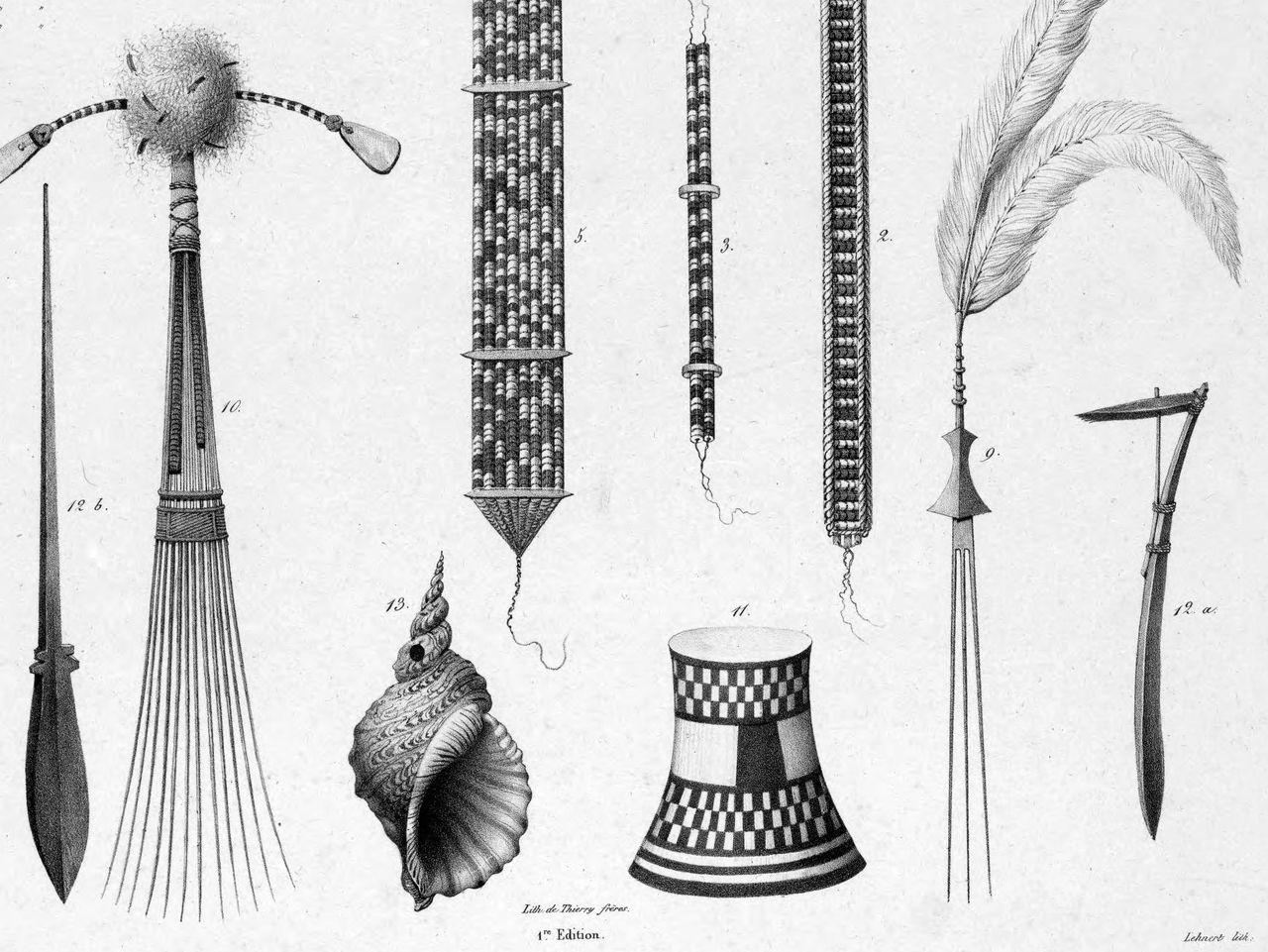
Lithograph of numbered objects drawn as specimens on a pale ground: a comb topped with a fibre tuft and a crossbar, a second comb with two feathers, three long bead necklaces, a conch shell, a flared ear ornament with a checked pattern, and two pointed tattooing instruments.Open the full image, without the site’s colour treatment

Photo not loaded, to save data.

Ornaments and instruments of the Caroline Islanders, drawn by Aleksandr Postels on the Russian corvette Seniavin’s voyage of 1826–29: combs, necklaces, an ear ornament, tattooing instruments and a conch used as a trumpet. Detail of plate 30.

A. Postels and P. F. Lehnert, “Ornements et instruments des habitants des îles Carolines”, pl. 30, in Voyage autour du monde … sur la corvette Le Séniavine, sous le commandement de Frédéric Lutké (Paris: Engelmann, 1831–1839). National Library of Russia, via World Digital Library / Library of Congress.

In this chapter 12 parts

Explorers mapped the islands from 1824

Duperrey’s French ship Coquille anchored at Kosrae from 5 to 15 June 1824, then spent five days from 24 June circling Chuuk’s reef.1 Kosrae history outline, COM-FSM; Lesson 1839; Hezel, Truk It also mapped Chuuk Lagoon from outside the reef, and its charts served ships for decades.2 Hezel, “Beginnings of Foreign Contact in Truk”

Manuel Dublon’s brig San Antonio entered the lagoon on 10 December 1814.3 Hezel, Truk Dublon’s own record has never been found.

Lütke’s Russian sloop Senyavin reached Kosrae in early December 1827, found the people friendly and left about 3 January 1828.4 Lütke, vol. I; Miklukho-Maclay Foundation These are Gregorian dates; Russian sources give Julian dates 12 days earlier.

At Pohnpei, about forty canoes surrounded the ship from 14 January 1828.5 Lütke, vol. II Only one man came aboard, and Lütke refused to force a landing. Canoe men gave him place names.

He found iron tools in the Mortlocks and Spanish words in the Mortlocks and Namonuito.6 Hezel, Truk; Lütke, vol. II He spent only about a day off Chuuk’s reef.

Beachcombers and whalers made Pohnpei and Kosrae hubs

Pohnpei’s beach community grew from about 50 whites in 1840 to about 150 by 1850.7 Hezel, “Role of the Beachcombers” They worked as pilots, carpenters and trade middlemen who set produce prices until the 1850s. By about 1870 their number fell back to 50 as Pohnpeians took over trade.

The best-known beachcomber, James O’Connell, was living on Pohnpei around 1830. His published account describes his tattooing and marriage, but even a sympathetic museum essay calls its truth “an open question”.8 Rhode Island Historical Society Hezel and the RIHS cite different titles and editions, and neither page confirms the first-publication year.

Kosrae became a favored whaling stop, with 76 whaleships calling between 1852 and 1856.9 Kosrae outline Violence ran both ways: Kosraeans killed a ship’s crew at Lelu in 1835 and burned another ship at Okat around 1843. The outline names that ship the Henrietta, while Hezel names the Harriett and dates the attack to 1842;10 Hezel, Beachcombers Hezel’s scholarly survey is the better guide.

In July 1837 the Sydney cutter Lambton attacked Ngatik (Sapwuahfik) in search of turtle shell.11 Wikipedia, Ngatik massacre Lin Poyer says nearly every adult man was killed, while another writer says about 20 survived. The crew and Pohnpeians then repopulated the atoll, giving rise to Ngatik Men’s Creole.

Chuuk and Yap kept outsiders away longer

Chuuk earned the label “Dreaded Hogoleu” after an 1844 attack on Andrew Cheyne’s ship and his later warnings to sailors.12 Hezel, Truk In December 1838 Dumont d’Urville’s ships surveyed Chuuk Lagoon. A clash off Fefan ended with the French killing ten or twelve Chuukese.13 Hezel, Truk

British warships burned Chuukese villages and canoes in 1862. Hezel argues the reputation was partly undeserved and rooted in village warfare and scarce food.14 Hezel, Truk

Yap had virtually no beachcombers; Hezel calls it “just as inhospitable” to them.15 Hezel, “Role of the Beachcombers” Yapese discouraged visitors, and leaving a party ashore was not thought safe until 1866. Around 1871–1875, labor recruiters also took dozens of Mortlockese to Fiji and Samoa, though most were later returned.16 Hezel, Truk

Missions came through Hawaii and then Pohnpei

A Catholic priest, Désiré Maigret, landed on Pohnpei in mid-December 1837 and left on 29 July 1838 without converts.17 Charlot 1969 MicSem says he stayed six months.18 MicSem, Catholic Church history: Pohnpei

In 1852 three American couples and two Hawaiian families began the Protestant mission on Pohnpei and Kosrae.19 MicSem Protestant album On Kosrae, Benjamin Snow worked under the protection of King Lepalik I.20 Kosrae outline

By 1887, half of Pohnpei’s people were Protestant church members.21 MicSem Catholic history Pohnpeian teacher couples landed in the Mortlocks in 1874 and built churches with over 800 members within three years. The first resident American missionary reached Chuuk only in 1884, so islanders carried Christianity there first.22 Hezel, Truk

Disease cut Pohnpei and Kosrae deepest

In 1854 the whaler Delta put smallpox-stricken sailors ashore on Pohnpei.23 Hezel, “Disease in Micronesia” The epidemic killed about 4,000 people, roughly 40% of the island. Kitti alone fell from 2,156 people in May to 1,039 by October.

Kosrae’s collapse was even steeper. Hezel estimates about 3,000 people in 1838 and about 300 by around 1890, a 90% drop.24 Hezel, “Disease in Micronesia” Eyewitnesses counted far fewer: Lesson put Kosrae at 1,200 at most in 1824, and Lütke at 800 adults in 1827.25 Lesson; Lütke, vol. I

A COM-FSM chronology gives “below 200” by 1880; Hezel’s figure is the better-supported scholarly estimate, but the low point may have come earlier.26 Kosrae outline

Yap and Chuuk suffered less because ships rarely called before the copra era. Still, an illness Cheyne landed on Yap in 1843 killed 50 people in Tomil in three days.27 Hezel, “Disease in Micronesia” Hezel estimates Micronesia’s population fell 30–40% across the century.

Kosrae rebuilt its politics around king and church

As Kosrae’s population fell, its chiefly titles shrank from 18 in 1837 to five by 1880.28 Kosrae outline King Awane Oa expelled plotters and banned permanent white settlement in 1857. Sru IV became the first elected king in 1874, and formal class distinctions ended in 1884.

Raiders and traders put guns into chiefly rivalries

On 1 April 1865 the Confederate raider Shenandoah burned four whalers in Madolenihmw.29 Vance et al., World History Connected The Nahnmwarki shared out about 120 stranded sailors among clan chiefs. The rival Wasai, left out, “just fell short of all-out war,” and firearms on the island increased.30 Kosrae outline

Godeffroy opened Yap’s first permanent trade station in 1869 and a Kosrae copra station in 1870.31 Hezel, O’Keefe; Kosrae outline August Hartmann became Chuuk’s first resident trader in 1874. By about 1900 some 35 traders there sold guns, dynamite and liquor.32 Hezel, Truk

Irish-born David O’Keefe reached Yap in 1872 or 1873 and shipped Palauan stone money (rai) to Yap for copra.33 Hezel, O’Keefe A Smithsonian page says he “single-handedly introduced inflation” into Yap’s stone-money system.34 Smithsonian Hezel argues the “King of Yap” myth, born of a 1950 novel, has eclipsed the man.

Key events

  1. 18237 Jun
    Yap Outer islands

    The James Scott (John Mackenzie) trades with Ulithi canoes and names the atoll the “Mackenzie Group.”

    Source: MicSem ship list: Yap

  2. 18323 Jan
    Pohnpei

    Capt. J. H. Eagleston of the barque Peru sights Pohnpei, already charted as “Ascension Island.”

    Source: Wikipedia, Pohnpei

  3. 183814 Jun
    Pohnpei

    The Mermaid (Eagleston) finds islanders “very friendly” and sees the fortifications at Nan Madol.

    Source: MicSem ship list: Pohnpei

  4. 184627 Feb
    Chuuk Outer islands

    Islanders show the Zotoff (Benjamin Wallis) bêche-de-mer grounds at Satawan, Lukunor and Etal.

    Source: MicSem ship list: Chuuk Hezel, Truk

  5. 1852Dec
    Kosrae

    Snow begins formal church services with King Lepalik I’s support.

    Source: COM-FSM Kosrae outline

  6. 18591 Apr
    Kosrae

    The whaler Lexington wrecks on a Kosrae reef; some crew build a vessel and sail to Hong Kong.

    Source: MicSem ship list: Kosrae

  7. 1867Oct
    Kosrae

    Kosrae’s church has 197 members; a stone church is dedicated during Morning Star II’s visit.

    Source: COM-FSM Kosrae outline MicSem ship list: Kosrae

  8. 187528 Mar
    Yap Outer islands

    The Rupak finds Woleai’s people starving, with an Englishman living ashore.

    Source: MicSem ship list: Yap

  9. 1881May
    Chuuk

    The Caroline (Felix Becker) leaves a resident trader on Ulul.

    Source: MicSem ship list: Chuuk

  10. 188517 Dec
    National

    Spain and Germany sign the Rome protocol embodying the papal settlement.

    Source: Gaceta de Madrid, 10 Jan 1886

All 210 events from these years in the timeline

People

Fyodor Lütke
Russian navigator whose sloop Senyavin visited Kosrae, Pohnpei, the Mortlocks and Chuuk in 1827–28.
Désiré Maigret
Catholic priest who spent 1837–38 on Pohnpei without making converts.
David O’Keefe
Irish-born trader on Yap who shipped Palauan stone money in exchange for copra from the 1870s.

Where sources disagree in this era

  • German flag on Yap

    25 Augor2 Aug 1885

    Better supported 25 August (fits Spanish arrival) Source not yet linked

Every contested fact, in one table

Through other eyes

Records from the time in other languages, each shown in the original beside an English translation, with what it settles.

Duperrey’s Coquille at Kosrae and Chuuk, 1824French and Russian records, 1 source

René-Primevère Lesson, Voyage autour du monde… sur la corvette La Coquille (Paris, 1838–39), Internet Archive scan pp. 802–865, search-inside

Original, French:

«Cette terre haute est l'île de Oualan.»

English translation:

“This high land is the island of Oualan.”

Original, French:

«Pendant les dix jours que nous passâmes au havre de [la Coquille]»

English translation:

“During the ten days we spent at the harbour of [la Coquille].”

Original, French:

«en estimant à 1200 personnes, au plus, la totalité de la population»

English translation:

“estimating the whole population at 1,200 persons at most.”

Original, French:

«L'hospitalité est un caractère distinctif des habitants de Oualan»

English translation:

“Hospitality is a distinctive trait of the inhabitants of Oualan.”

What it settles: the Coquille sighted Kosrae on 3 June 1824, entered harbor on 5 June and left on 15 June. Lesson counted about 100 chiefs under a paramount titled “Urosse toll” on Lelu. His 1,200 ceiling sits far below Hezel’s 3,000 for 1838.

Summary (not a quote): Hezel says the Coquille spent five days from 24 June 1824 off Chuuk’s reef without entering the lagoon. It drew the first European chart of the lagoon (Hezel).

All French and Russian records in Through other eyes

Dumont d’Urville at Chuuk, 1838French and Russian records, 1 source

Francis X. Hezel, “The Beginnings of Foreign Contact in Truk,” citing Dumont d’Urville, Voyage au Pôle sud (1841–46), vol. V, MicSem

Published translation (Hezel, not the research team): “The reputation of the Carolines has been tarnished, for we have found here treacherous and wicked people.”

What it settles: the Astrolabe and Zélée entered Chuuk Lagoon on 22 December 1838. A clash between Fefan and Dublon ended with the French “killing ten or twelve natives.” This violence predates the 1844 Cheyne attack behind the “Dreaded Hogoleu” label.

All French and Russian records in Through other eyes

Lütke’s Senyavin, 1827–1828French and Russian records, 4 sources

Fyodor Lütke, Voyage autour du monde… sur la corvette Le Séniavine, French ed. tr. F. Boyé (Paris, 1835–36), vol. I, Internet Archive p. 374, search-inside

Original, French:

«on peut porter la population entière d'Ualan à huit cents âmes»

English translation:

“the entire population of Ualan may be put at eight hundred souls.”

What it settles: Lütke counted about 800 Kosraean adults, excluding children. He reached Kosrae in early December 1827 and left about 3 January 1828, by the Gregorian calendar.

Lütke, Russian edition (St Petersburg, 1834–36), part I, pp. 285–286, quoted in Vinogradova, Страны и народы Востока XXIV (1982), PDF

Original, Russian:

«Покойная гавань, хороший климат, добрый народ, изобилие пресной воды и плодов…»

English translation:

“A calm harbour, a good climate, a kind people, an abundance of fresh water and fruit…”

What it settles: the Russian original matches the French picture of a peaceful Kosrae. Russian sources use Julian dates, 12 days earlier than the French edition.

Lütke, French ed., vol. II, pp. 4, 15, 33, Internet Archive text

Original, French:

«ce ne fut qu'avec beaucoup de peine que je pus en décider un seul à monter à bord»

English translation:

“it was only with great difficulty that I could persuade a single one to come aboard.”

Original, French:

«plutôt que d'acheter cette satisfaction au prix du sang»

English translation:

“rather than buy this satisfaction at the price of blood.”

Original, French:

«le nom de la grande île est, en effet, Pouynipète»

English translation:

“the name of the large island is indeed Pouynipète.”

What it settles: about forty canoes met the ship at Pohnpei from 14 January 1828, but only one man came aboard. Lütke refused to force a landing and named the “Port of Bad Reception.” Canoe men gave place names; no Pohnpeian word list was found.

Lütke, French ed., vol. II, Internet Archive pp. 65, 339, search-inside

Original, French:

«avaient certainement été faits à Pouynipète»

English translation:

“had certainly been made on Pouynipète.”

Original, French:

«D'après sa grandeur, on peut l'estimer à mille individus»

English translation:

“Judging by its size, one may estimate it at a thousand individuals.”

What it settles: Mortlockese mistook the ship’s mahogany furniture for Pohnpeian work and feared Pohnpeian warriors. Lütke spent about a day off Chuuk (“Roug”) on 14–15 February 1828 and only guessed its population. The iron tools and Spanish words he noted were in the Mortlocks and Namonuito.

All French and Russian records in Through other eyes

Maigret on Pohnpei, 1837–1838French and Russian records, 1 source

Jean Charlot, “Introduction au Journal de Louis Désiré Maigret,” Journal de la Société des Océanistes 25 (1969), Charlot Foundation

Original, French:

«ermite malgré lui sur l'île de Ponapé»

English translation:

“a hermit in spite of himself on the island of Ponape.”

Original, French:

«je m'en vais, disait-il, je m'en vais»

English translation:

“‘I’m leaving,’ he said, ‘I’m leaving’.”

What it settles: Charlot’s diary transcription dates the stay from mid-December 1837 to 29 July 1838. That is about seven and a half months, supporting “seven months” (Charlot English text). MicSem’s page says six months, so the diary is the better source.

All French and Russian records in Through other eyes

All foreign-language records

Notes

  1. Kosrae history outline, COM-FSM; Lesson 1839; Hezel, Truk ↑
  2. Hezel, “Beginnings of Foreign Contact in Truk” ↑
  3. Hezel, Truk ↑
  4. Lütke, vol. I; Miklukho-Maclay Foundation ↑
  5. Lütke, vol. II ↑
  6. Hezel, Truk; Lütke, vol. II ↑
  7. Hezel, “Role of the Beachcombers” ↑
  8. Rhode Island Historical Society ↑
  9. Kosrae outline ↑
  10. Hezel, Beachcombers ↑
  11. Wikipedia, Ngatik massacre ↑
  12. Hezel, Truk ↑
  13. Hezel, Truk ↑
  14. Hezel, Truk ↑
  15. Hezel, “Role of the Beachcombers” ↑
  16. Hezel, Truk ↑
  17. Charlot 1969 ↑
  18. MicSem, Catholic Church history: Pohnpei ↑
  19. MicSem Protestant album ↑
  20. Kosrae outline ↑
  21. MicSem Catholic history ↑
  22. Hezel, Truk ↑
  23. Hezel, “Disease in Micronesia” ↑
  24. Hezel, “Disease in Micronesia” ↑
  25. Lesson; Lütke, vol. I ↑
  26. Kosrae outline ↑
  27. Hezel, “Disease in Micronesia” ↑
  28. Kosrae outline ↑
  29. Vance et al., World History Connected ↑
  30. Kosrae outline ↑
  31. Hezel, O’Keefe; Kosrae outline ↑
  32. Hezel, Truk ↑
  33. Hezel, O’Keefe ↑
  34. Smithsonian ↑
Cite this page
APA Chicago Link